The Hidden Cost of Complacency in Sales Organizations (It's Not What You Think)
Most sales leaders believe their biggest competitive threat lives outside the organization — a smarter competitor, a more aggressive pricing strategy, a market shift they didn't see coming.
After working with over 100,000 sales professionals and leaders across multiple countries, I can tell you with confidence: that belief is costing them millions.
The biggest threat to sustained sales performance isn't the competitor down the street. It's the quiet, gradual drift toward 'good enough' that happens inside your own organization — often among your best people — when external pressure drops.
That drift has a name: complacency. And its costs are largely invisible until they aren't.
Why Complacency Is So Hard to Diagnose
Here's what makes organizational complacency so dangerous: it doesn't look like failure. It looks like stability.
The team is hitting quota — most quarters, anyway. The culture feels solid. People aren't leaving in droves. From the outside, things look fine. But inside the organization, if you know what to look for, the signals are already there:
Consistent quarters but no growth quarter-over-quarter. Your team isn't declining, but they're not improving either. They've found a comfortable plateau and stopped pushing through it.
Best performers with surprisingly flat trajectories. The rep who was your top performer two years ago is still your top performer — but they're not significantly better than they were. They've plateaued, and nobody has noticed because they're still #1 on the board.
Declining urgency in the middle of the quarter. The team runs hard in the last two weeks of the quarter and coasts the first two. This is a classic sign that external pressure (quota deadlines) is doing all the motivational work — which means when that pressure drops, so does performance.
Exits that catch you off guard. A top performer puts in their notice, and it comes as a shock. It never should. Voluntary exits among your best people almost always follow a period of internal disengagement — and disengagement is complacency's first cousin.
The Real Numbers Behind the 'Good Enough' Problem
The financial cost of complacency is almost never measured directly — which is why it's so easy to ignore. But if you want to pressure-test how much it's actually costing your organization, start here:
The performance gap between your best and average quarters: If your team averages $2M in a strong quarter and $1.4M in a soft one, that $600K gap is your complacency tax. It's the difference between what your team is capable of and what they're actually delivering when external pressure isn't forcing their best.
The cost of coasting just below full potential: Research consistently shows that engaged, growth-oriented employees outperform their disengaged counterparts by 20-25%. If you have a 20-person sales team earning $200K OTE and they're underperforming by even 15%, that's $600K in annual revenue leaking out of a team that's technically showing up every day.
Replacement costs you should never be paying: Gallup research shows the cost to replace a high-performing employee runs between 50-200% of their annual salary. When your best people leave because they stopped growing — not because a competitor poached them — that's a preventable cost. And the root cause, almost always, is a culture that stopped challenging them.
The Three Places Complacency Hides in Sales Organizations
Complacency doesn't announce itself. It hides in three specific places, and most leaders aren't looking in the right spots:
In the success of your winners: Your top performers are the highest-risk population for complacency, aka Victory Drift — not your underperformers. Underperformers get managed. Winners get left alone. And when you leave your best people to manage themselves indefinitely, they eventually find their own comfortable floor and stop pushing beyond it.
In your leadership team: I work with organizations where the front-line sales culture is hungry and competitive, but the leadership team — the people who won market share three to five years ago and built the division — has quietly drifted. They're not failing. They're protecting. Comfort Drift is what we call it. And protecting cultures don't attract or retain competitors.
In your recognition systems, most programs reward outcomes (e.g., quota attainment, annual awards) rather than improvement. When only the score gets celebrated, people optimize for the score — not for getting better. Over time, this bakes complacency into your incentive architecture.
What Anti-Complacency Training Actually Does
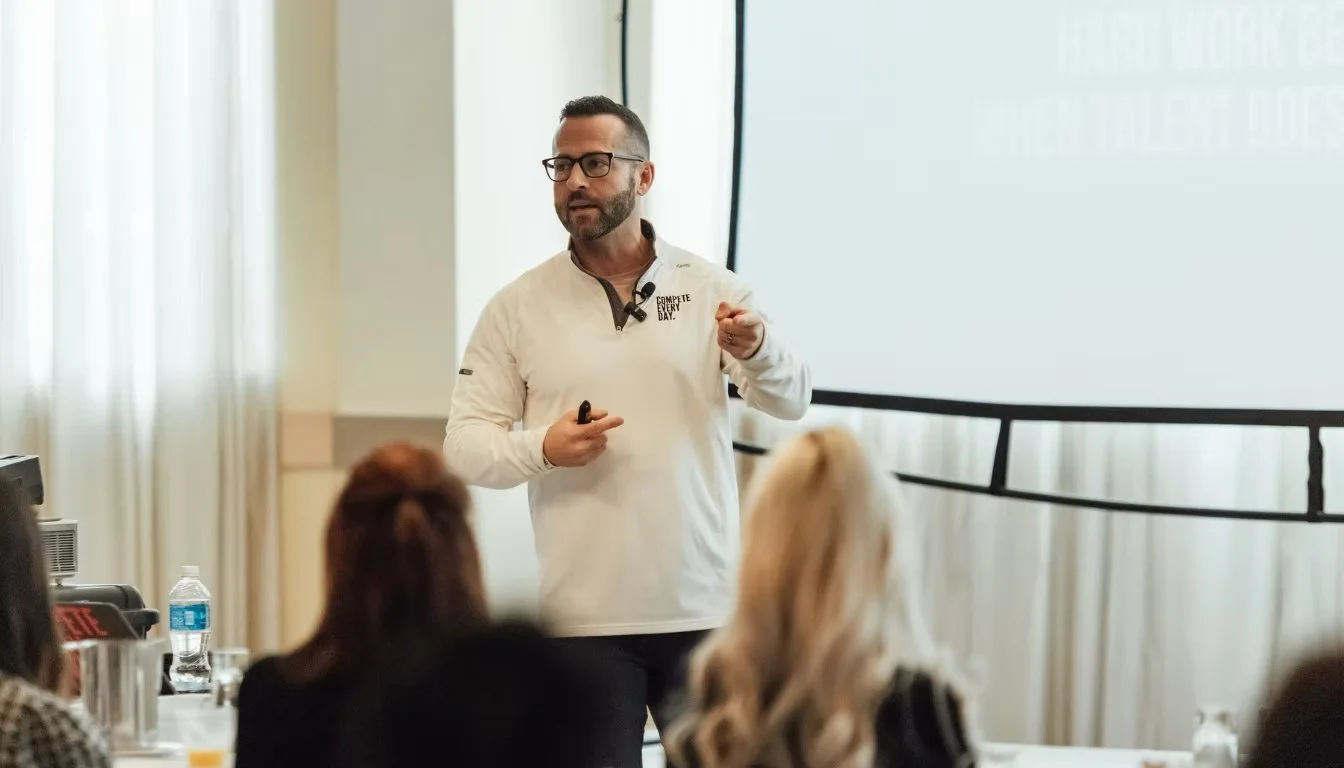
When I deliver keynotes and training programs for sales organizations, I'm not there to motivate people. Motivation is temporary — it fades by Tuesday after most conferences. What I'm there to do is help organizations build a competitive system that doesn't depend on external pressure to produce elite behavior.
The C.O.M.P.E.T.E. Framework® is the system I use. It's a seven-step model that teaches sales teams and their leaders to compete daily — against themselves, against yesterday's results, against the standard they've set for the kind of professional they want to be — rather than competing only against external benchmarks that eventually stop working.
The outcomes aren't theoretical. Almost half of all of our keynote program clients bring us back or engage us in additional training and coaching because they experienced a program that actually works. In an industry where most speaker deliver a talk maybe every 4-5 years to a client, or only once, we continue to work with great teams because their people are getting consistent results.
The Question Worth Sitting With
Here's the honest question for any sales leader reading this: If your team removed all external competitive pressure tomorrow — the quota, the leaderboard, the contest — would they still compete at the same level?
If the answer is no, you have a complacency problem hiding underneath a performance management system that's masking it. And the time to fix it is before it becomes a crisis — not the quarter after you lose your second-best rep and can't explain why.
Jake Thompson is an anti-complacency keynote speaker who trains sales-led organizations to identify and eliminate the hidden costs of drift before they compound into a culture problem. As a CSP® (Certified Speaking Professional) with 500+ keynotes delivered across pharmaceutical sales, financial services, insurance, real estate, and construction, Jake brings proven frameworks — including the C.O.M.P.E.T.E. Framework® and Beat Yesterday® methodology — to sales kickoffs, leadership summits, and annual conferences. Learn more at JakeAThompson.com.